From Artificial Intelligence to Superintelligence… Could a Name Change the Future of Technology?
U.S. President Donald Trump’s announcement that the term Artificial Intelligence (AI) should be replaced by Super Intelligence (SI) was not merely a passing linguistic proposal. Rather, it carries implications that go beyond terminology, touching on how one of the most important technologies of our time is presented to society and the wider world.
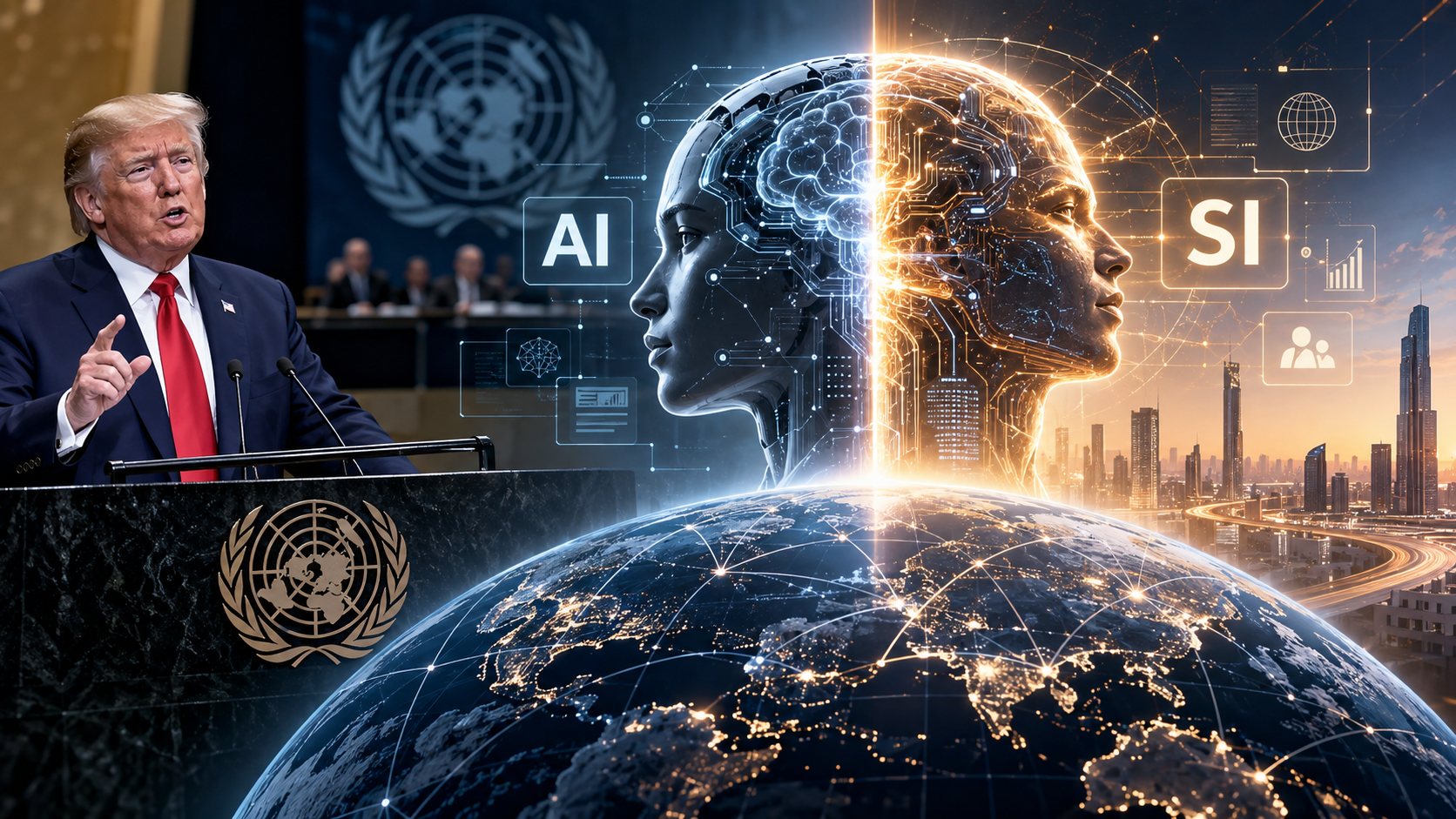
In his address to the United Nations General Assembly on September 22, 2026, Trump announced that U.S. documents would use the term Super Intelligence (SI) instead of Artificial Intelligence (AI), expressing his hope that the new terminology would eventually gain global acceptance. He argued that the word artificial might make this form of intelligence sound fake or unreal, whereas, in his view, what we are witnessing today is a real and remarkable technological phenomenon that will have profound consequences for the future of humanity.
The significance of such a change, however, lies in more than simply replacing one word with another. Language shapes the way we perceive things. When we say Artificial Intelligence, the emphasis is placed on the origin of the intelligence: it is created by humans through machines, algorithms, and computational systems. When we say Super Intelligence, however, the focus shifts from the source of intelligence to the level of its capability and superiority. This is where the real conceptual shift in terminology lies.
The new terminology may also reflect a broader political and economic vision. Artificial intelligence is no longer merely a technological tool for improving productivity or retrieving information. It has become part of an international competition for knowledge, economic power, and national security. From this perspective, Trump’s preference for the new term can be understood as an attempt to portray the United States as being at the forefront of the race toward a new era of intelligence and technology.
Nevertheless, the proposed name raises an important scientific issue. The term superintelligence already exists in the literature on artificial intelligence and is generally used to describe a hypothetical level of intelligence that surpasses human capabilities across a broad range of domains. Applying the term to today’s AI technologies could therefore blur the distinction between what existing systems can actually accomplish and a far more advanced stage of machine intelligence that has not yet been achieved.
Perhaps the deeper significance of this debate is that humanity has entered a stage in which the central question is no longer simply, “What can machines do?” It now extends to a much larger question: “How should we define intelligence itself in an age when machines have become partners with humans in the production of knowledge?”
The transition from AI to SI, if it becomes globally established, would therefore represent more than a change in the vocabulary of technology. It would constitute an attempt to reshape the way technology is perceived in the human imagination. Yet the most important truth remains that changing the name does not change the nature of the technology, its risks, or its possibilities. The real value lies not in whether we call it “artificial” or “super,” but in how we use this intelligence, the ethical boundaries we establish for it, and the role we want it to play in shaping the future of humanity.