Foreign Minister Delivers Saudi Arabia's Address at 81st UN General Assembly
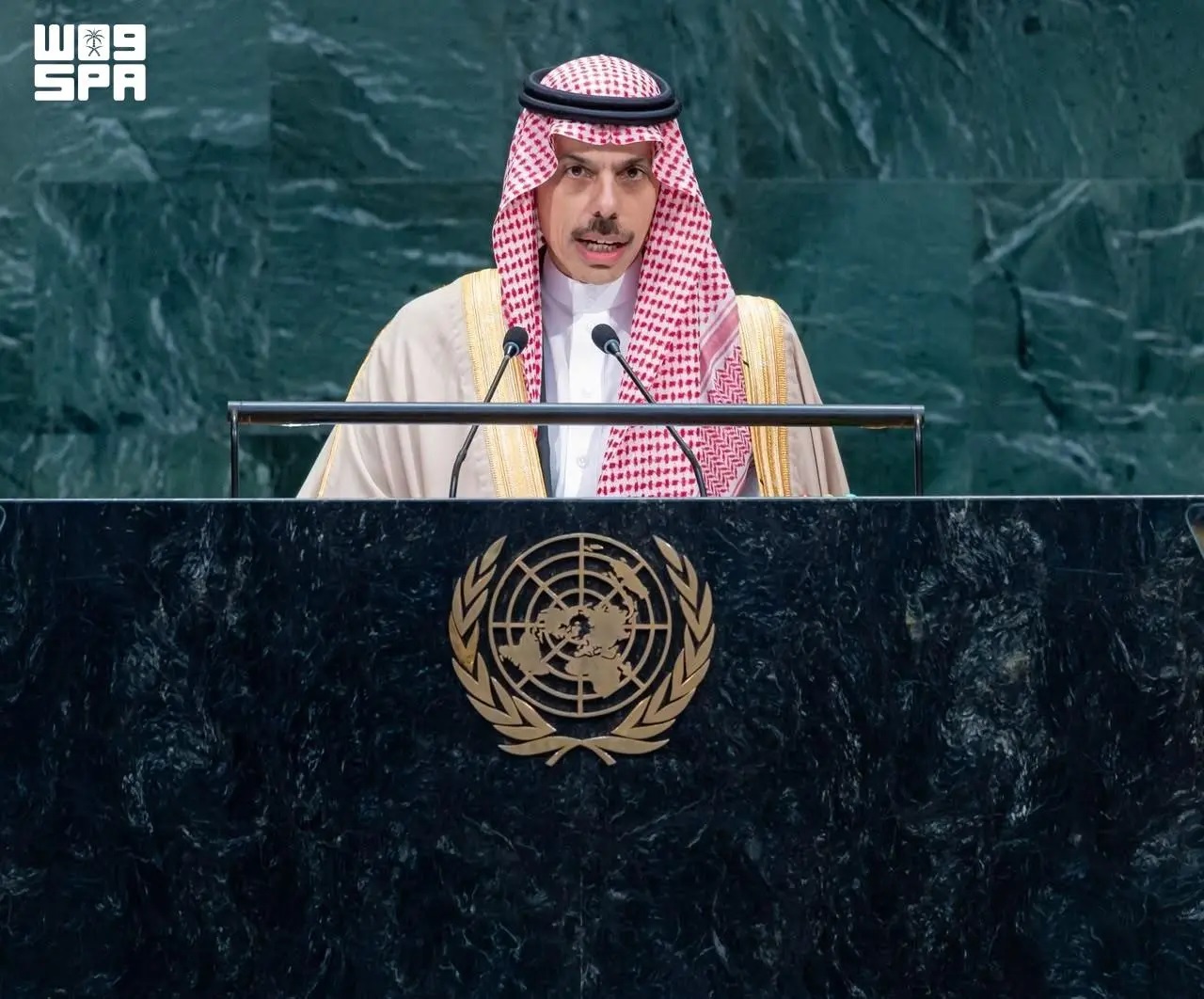
Minister of Foreign Affairs Prince Faisal bin Farhan bin Abdullah delivered the Kingdom of Saudi Arabia's address on Saturday at the 81st session of the United Nations General Assembly in New York. The full text follows:
"In the name of Allah, the Most Gracious, the Most Merciful.
Your Majesties, Excellencies, and Highnesses,
His Excellency the President of the United Nations General Assembly,
His Excellency the Secretary-General of the United Nations,
Distinguished delegates,
May the peace, mercy, and blessings of Allah be upon you.
At the outset, we congratulate Khalilur Rahman on his election as president of the 81st session of the United Nations General Assembly and wish him success in leading its work. We also thank Annalena Baerbock for her efforts as president of the 80th session.
We express our deep gratitude and appreciation to Secretary-General of the United Nations Ant?nio Guterres for his continuous efforts to serve the purposes of the United Nations.
Mr. President, this session meets at a time when the world and the multilateral system face rapid and unprecedented challenges. With crises and conflicts persisting in many parts of the world, there is a growing need to uphold the principles of the UN Charter, respect international law, and strengthen the effectiveness of international institutions in maintaining peace and security and achieving sustainable development.
Mr. President, crises stem less from a lack of resources or opportunities than from a lack of commitment to the principles agreed upon by the international community.
The Kingdom of Saudi Arabia and countries in the region have been subjected to blatant Iranian attacks targeting their security, national assets, and civilian and economic facilities. Saudi Arabia reaffirms its full right to protect its security, sovereignty, citizens, residents, and national assets, and calls on the international community to shoulder its responsibilities in confronting all threats to international peace and security.
The security of the Arabian Gulf region is an integral part of regional and global security, and the stability of this vital region is directly linked to global energy security, the continuity of international trade, and the sustainability of global supply chains.
Mr. President, protecting international navigation and ensuring the sustainability of global supply chains is a shared responsibility. It requires serious international cooperation so that the global economy is not exposed to risks that affect the entire world. The Kingdom of Saudi Arabia therefore emphasizes the importance of guaranteeing freedom of navigation in all international waterways, foremost among them the Strait of Hormuz, the Bab al-Mandab Strait, the Red Sea, and the Gulf of Aden. It calls for the situation in the Strait of Hormuz to return to its status before February 28, without the imposition of any fees or restrictions. In accordance with international law and relevant UN resolutions, the Kingdom rejects the use of these vital waterways by any party as a tool of pressure, threats, or harm to the interests of nations.
Efforts to restore security and stability in the region and to build sustainable relations among its states cannot be founded on hegemony, the imposition of influence, or the exploitation of crises. They must rest on mutual respect, shared interests, good-neighborliness, respect for state sovereignty, and full adherence to international law and international humanitarian law. On this basis, the Kingdom supports the efforts and initiatives that contribute to de-escalation, foremost among them the efforts of Qatar, Pakistan, and other brotherly and friendly nations, helping restore stability to the region and create conditions for dialogue and diplomacy. Saudi Arabia emphasizes the importance of ensuring that any security arrangements for the region are comprehensive, effective, and sustainable, and that they clearly address the sources of threat and instability. It also stresses the need to make the region entirely free of weapons of mass destruction and to subject peaceful nuclear programs to international oversight, verification, and safeguards, in a way that builds trust and upholds regional and international security.
Mr. President, the Israeli occupation's targeting of civilians, obstruction of humanitarian aid, attempts at forced displacement, and continued illegal settlement expansion compound the ongoing suffering of the Palestinian people in Gaza Strip and the West Bank. They constitute grave violations of international law and international humanitarian law. The Kingdom reaffirms its rejection of all attempts at displacement or at changing the reality on the ground in the Palestinian territories. It emphasizes that a just and lasting peace can be achieved only by implementing the two-state solution and establishing an independent Palestinian state on the 1967 borders, with East Jerusalem as its capital.
Saudi Arabia underscores the importance of supporting efforts to reach a comprehensive political solution that ensures Yemen's stability, strengthens its economy, and alleviates the humanitarian suffering of its brotherly people. The Kingdom has provided more than $29 billion in humanitarian and development aid to the Republic of Yemen, and was the country's top humanitarian donor in 2025.
In this context, the Kingdom welcomes the statement by members of the Security Council condemning the missile and drone attacks launched by the terrorist Houthi militia against Saudi Arabia and commercial vessels. It calls on the international community to reject and condemn the terrorist Houthi militia's acts of aggression and criminal attacks, and its attempts to threaten the security of navigation in the Red Sea and the Bab al-Mandab Strait.
Regarding Sudan, the Kingdom emphasizes the importance of Sudan's stability and of preserving its unity, territorial integrity, national assets, and institutions. It affirms that any solution to the crisis must come through a Sudanese-led political process that respects Sudan's sovereignty and unity, supports its state institutions, fulfills the aspirations of the Sudanese people, alleviates their humanitarian suffering, and strengthens the country's security and stability.
Saudi Arabia supports all efforts to strengthen Syria's security, stability, and territorial integrity. It welcomes the United States' decision to rescind Syria's designation as a state sponsor of terrorism, which will help the country embark on reconstruction and development. The Kingdom rejects any violations that undermine efforts to restore security and stability in Syria or infringe on its sovereignty and territorial integrity.
On Lebanon, the Kingdom reiterates its support for the Lebanese state and its legitimate institutions, the implementation of the Taif Agreement, the restriction of arms to the state, and the preservation of Lebanon's sovereignty, security, and stability.
The Kingdom affirms its support for all efforts that contribute to the security, stability, and prosperity of Iraq and its people. It looks forward to constructive steps by the Iraqi government to consolidate security, ensure independent decision-making, and restrict arms to the state. Such steps would uphold Iraq's sovereignty, preserve its security and stability, and ensure that Iraqi territory does not become a source of aggression against neighboring countries.
Ten years after its launch, the achievements of Saudi Vision 2030 represent a model of comprehensive national transformation. That model is grounded in economic diversification, investment in human capital, the promotion of innovation, the empowerment of youth and women, private sector development, and a firm commitment to sustainability. The Vision has helped establish the Kingdom of Saudi Arabia as a regional and international hub for business, investment, tourism, industry, technology, and logistics. Non-oil activities now account for 55% of GDP, and unemployment among Saudis fell to 6.4% in 2026 from 12.3% in 2016.
Energy security depends on the strength and resilience of the energy system and its capacity to withstand and adapt to disruptions. Ensuring stable energy supplies, protecting critical infrastructure, diversifying supply routes, and safeguarding freedom of navigation are shared responsibility that requires sustained international cooperation. Saudi Arabia demonstrated this commitment in practice during the disruption to maritime traffic in the Strait of Hormuz: thanks to its long-term infrastructure investments, it kept energy supplies flowing without interruption. The East-West Pipeline, together with the Kingdom's petroleum stockpiles outside the region, helped mitigate the impact of the disruption and strengthened supply reliability for global markets.
The Kingdom affirms that energy security and climate action are complementary goals. On this basis, it emphasizes the importance of not excluding any energy source and of pursuing realistic, inclusive transition pathways that ensure energy security and protect the climate while supporting economic development. This approach has helped give the Kingdom one of the lowest carbon and methane emission intensities in the world in hydrocarbon production.
The Kingdom continues to develop a more efficient and sustainable energy system by deploying emission-reduction technologies, including carbon capture, utilization, storage, and removal; expanding renewable energy; harnessing innovation; and producing sustainable fuels such as clean hydrogen. These efforts support energy security, improve resource efficiency, and advance sustainability.
Amid the exceptional circumstances and rapidly escalating tensions in our region, the Kingdom of Saudi Arabia has helped stabilize regional and international trade, keep global trade flowing, and move imports and exports smoothly between its eastern and western coasts. This has served not only the Kingdom but also countries across the region and the world. During the current crisis, the Kingdom has also provided logistical support to neighboring countries by opening its airports and border crossings to the movement of people and goods, reflecting its commitment to its humanitarian, regional, and international responsibilities.
In light of rapid developments in artificial intelligence (AI) worldwide, the Kingdom emphasizes the importance of harnessing these technologies to serve humanity and advance development, while strengthening international cooperation to ensure their responsible use. The Kingdom took the lead in establishing the Global Network of Centres for Exchange and Cooperation on AI Capacity Building, an initiative stemming from the Pact for the Future. It also hosts the International Center for Artificial Intelligence Research and Ethics (ICAIRE) in Riyadh under the auspices of UNESCO. The center strengthens international cooperation in this field and helps establish ethical principles for the development and use of AI applications.
In conclusion, our world today requires the utmost wisdom, responsibility, and cooperation. The challenges we face cannot be met by any single nation acting alone, and security can be firmly established and sustained only through adherence to the principles of the UN Charter and respect for international law. The Kingdom will continue to work with its partners in the international community to advance sustainable development and peaceful solutions to crises, and to support every path that fosters stability, builds trust, and rests on mutual respect, in order to build a more secure and prosperous future for the region and the world."