On Behalf of HRH the Crown Prince, Vice Foreign Minister Participates in High-Level Commemorative Meeting Marking the 65th Anniversary of the First Conference of the Non-Aligned Movement
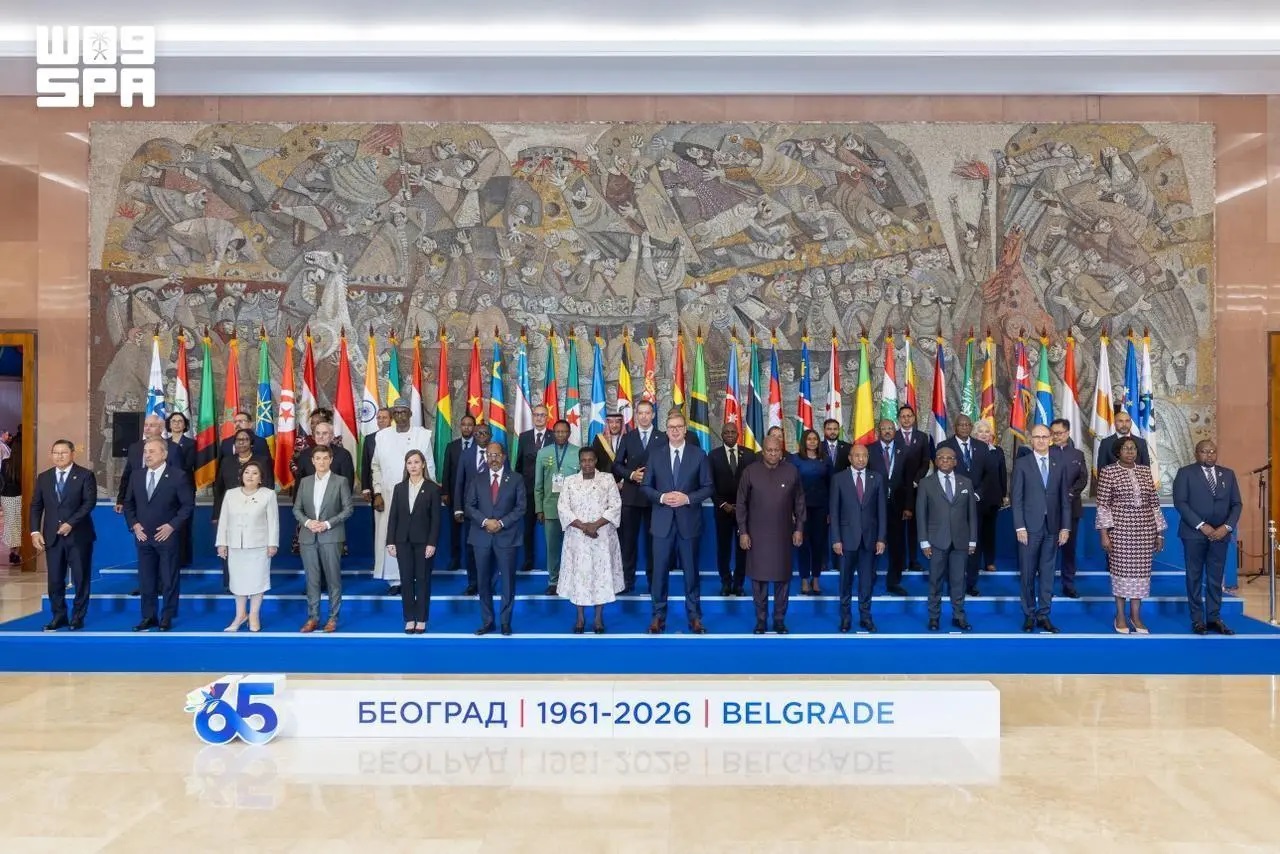
On behalf of His Royal Highness Prince Mohammed bin Salman bin Abdulaziz Al Saud, Crown Prince and Prime Minister, Vice Minister of Foreign Affairs Waleed Elkhereiji participated in the high-level commemorative meeting marking the 65th anniversary of the First Conference of the Non-Aligned Movement, held in the Republic of Serbia.
Elkhereiji delivered a speech in which he began by expressing the Kingdom of Saudi Arabia's appreciation to President of the Republic of Serbia Aleksandar Vučić, and his government for their valued efforts in hosting the meeting amid growing challenges facing the international community.
The vice minister of foreign affairs stated that, since contributing to the establishment of the Non-Aligned Movement, the Kingdom has remained committed to the principles upon which it was founded, foremost among them safeguarding the sovereignty of states and the independence of their national decision-making, and rejecting the use of force as a means of resolving disputes. These principles have been reflected in the Kingdom's foreign policy, which has relied on dialogue to address international issues, worked to broaden cooperative relations, and supported efforts to reduce the prospects of conflict and strengthen international peace and security.
Elkhereiji affirmed that the Kingdom values the Movement's principles and objectives as an important foundation for collective international action, as well as the responsible role it has played in supporting just causes, particularly its steadfast position on the Palestinian cause and its attention to the security and stability of the Middle East.
Elkhereiji stressed the importance of continued coordination through the United Nations and the Non-Aligned Movement in a manner that preserves the primacy of political solutions and prevents international law from being undermined by policies of force and escalation, including by ensuring freedom of navigation in international waterways, as recently reaffirmed by UN Security Council Resolution 2817.
The vice minister of foreign affairs explained that the consequences of the absence of political solutions are clearly evident in the Middle East, particularly as a result of the Israeli occupation's ongoing crimes in the Gaza Strip and throughout the Occupied Palestinian Territory, as well as its attacks on the territory of the Syrian Arab Republic. Such actions violate the rights of peoples and the sovereignty of states and push the region toward further tension and instability.
Elkhereiji reiterated the Kingdom's position that peace is the only option capable of ensuring lasting security for all countries and peoples of the region, and that this objective cannot be achieved without accelerating efforts to reach a just, comprehensive, and final settlement of the Palestinian cause.
The vice minister of foreign affairs said: "The Kingdom's regional efforts stem from the conviction that the security of the region is a shared responsibility and that its sustainability requires understandings that reduce the prospects of confrontation and prevent disputes from widening. Accordingly, the Kingdom has been keen to keep channels of communication open, support initiatives that contribute to de-escalation, and encourage parties to address the causes of tension before they develop into broader crises."
Elkhereiji added that the Kingdom views de-escalation not as a temporary objective, but as an opportunity for countries to redirect their priorities toward development and improving the lives of their peoples.
From this standpoint, the Kingdom calls on the countries of the region to avoid policies that heighten tensions and to work toward building shared interests that make stability a foundation for development and provide the peoples of the region with greater opportunities to realize their aspirations.